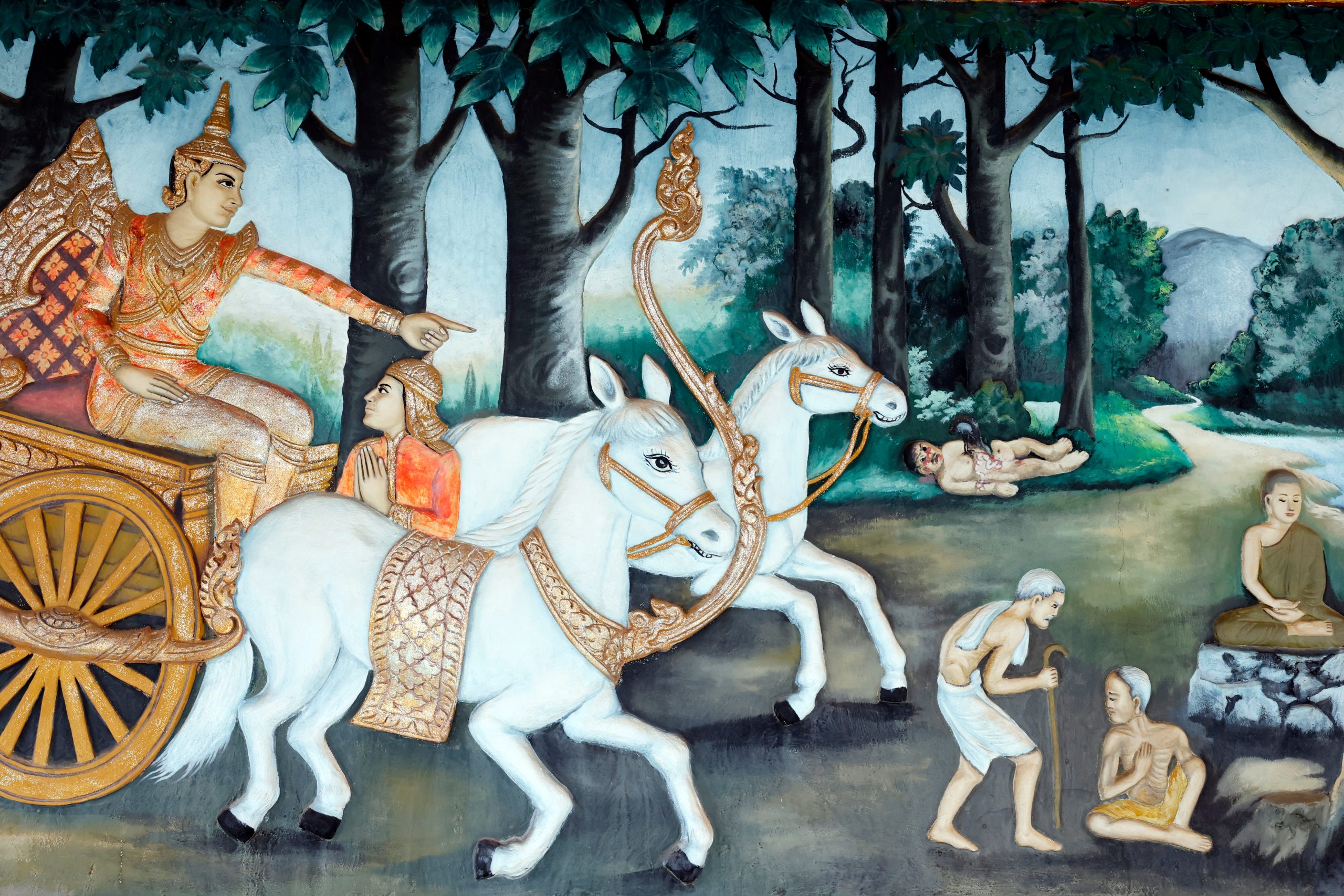
The great Buddhist poet Aśvaghoṣa famously tells the story of the Buddha’s father, the king, who tried to keep his son as an heir rather than a monk by isolating him from all the bad things in the world. Of course the king’s plan doesn’t work: the Buddha-to-be sneaks out and sees an old man, a sick man and a dead man, reminding him that these fates will come to a king as surely as anyone else, and so he renounces the world and becomes a monk. The story shows us that there always remains a gap between what is and what should be: we will always face sad facts like illness and death. That gap is bad, it is always with us, and that is unfortunate; it is just the way things are, whether we like it or not. It provides a need and an impetus for us to improve our minds, to escape the suffering that comes from craving in the face of those sad facts.
A very different take on that gap comes from Jacobin senior editor Alex Caring-Lobel in the Springer Handbook of Mindfulness, which collects over thirty essays objecting to the modern mindfulness movemennt. These essays take particular objection to David Gelles’s claim that “stress emanates from a mismatch between our expectation of how things should be and the way things are”. (p85) Caring-Lobel, in particular, objects to Gelles’s view because it
dismisses that glorious gap between “how things should be and the way there [sic] are” as a kind of impediment to flourishing. This is, after all, the space of the social imagination. It is also the space in which democracy operates. (Caring-Lobel p209)
Let’s spend some time with Caring-Lobel’s remarkable adjective, claiming that the gap between how things should be and the way they are is glorious, in order to understand just how remarkable it is. Inside the gap between how things should be and how they are, we find famines, plagues, racism, slavery, genocides: all things that are and yet should not be. Of course that gap is an impediment to flourishing. How could it not be?
Yet somehow Caring-Lobel manages to proclaim this locus of slavery and murder “glorious”, as a “space of the social imagination.” On such an account it is glorious that the Nazis took over Germany because that gave the Allies a chance to stop them; it aids human flourishing that famines exist, because we can imagine sending money to save people from them. I am reminded of nothing so much as pre-WWI celebrations of the glory of war: how wonderful it is that we have a chance to prove our manliness in combat! In Caring-Lobel’s topsy-turvy world, it is glorious that the world is filled with horrors, because it gives people like him a chance to come in and fix them.
I am not sure whether Caring-Lobel just never thought of his position’s shocking implications, or did think of them but didn’t feel he needed to bother defending them. But I do find positions like this surprisingly common. WEIRD people are so wedded to activism, find it so important, that in their eyes even genocides and famines become “glorious” because now they get an opportunity to stop them. The roots of such views are surely theological: there’s a close affinity here to the Christian theologian Richard Swinburne’s Maoist God, who creates a world in which innocent babies are tortured to death in order to provide an opportunity for privileged people like us to go in and save them. (Patton Oswalt provides a wonderful comedic skewering of one such theology, when it appears in the song “Christmas Shoes”).
But Caring-Lobel’s view takes one further step even beyond Swinburne. When Swinburne refers to the universe as half-finished, that at least suggests an end state where it will be finished: where we will have done the work that God betters us by doing, so that then we can finally enjoy a world without the torments of plagues and massacres, a world where we have closed the gap between what is and what should be. In that regard Swinburne is much like Karl Marx: for him, at least eventually we will get to a new social order that solves all our problems.
The Canadian philosopher George Grant notices this point about Marx, contrasting him favourably to those who seek social change for its own sake:
In the conceptions of history now prevalent among those ‘creative’ men who plan the mastery of the planet, changing the world becomes ever more an end in itself. It is undertaken less simply to overcome the natural accidents that frustrate our humanity and more and more for the sheer sake of the ‘creation’ of novelty. (27)
Grant is perhaps thinking of the capitalists who would become prominent in Silicon Valley, those who proclaim “disruptive innovation” as a positive good. Such men (and they remain mostly men) share a great deal in common with Caring-Lobel. For them as for him, the good end state is not the point; it is the process of changing things that is an end in itself. We shouldn’t even want to reach a utopia where no children starve, or where our work is no longer alienated, because it would leave no room for our intervention. It would close the “glorious gap”, the “space of the social imagination”. I can provide no better summary of such a position than the closing lines of Ross Coggins’s biting satirical poem “The Development Set”:
Enough of these verses – on with the mission!
Our task is as broad as the human condition!
Just pray to God the biblical promise is true:
The poor ye shall always have with you.
Now I think we can reasonably accept a pessimistic view, where there isn’t a way to close the gap between what is and what should be. There is a great deal in human history that would suggest such a pessimism – and indeed it’s a good match for Aśvaghoṣa, whose story is all about the inevitability of bad things. What’s not reasonable is to then think that this is glorious, that this is the way things should be.
There is a Daoist counterpoint here too. The Daodejing famously says that the Dao is in the piss and shit; I understand that claim in terms of a general Daoist project of acceptance, recognizing the need to “dwell within the flow” of things as they happen. Since the gap between what is and what should be is there, and is going to be there whether we like it or not, we need to make our peace with it. But the acceptance here is tied to the fact that we can’t change these things – that, as in Aśvaghoṣa, they are inevitable parts of life and therefore we must make our peace with them. Caring-Lobel gets it quite backwards: taking delight in the “glory” of the world’s horrors because they allow us white saviours to jump in and fix them. Yes, we do live better when we have a positive outlook toward life including its bad things – but that shouldn’t mislead us into thinking they are glorious.
This post’s content was originally written for my upcoming book; I left it out of the published version to make the argument flow a bit more smoothly. But if you like what you’ve just read here, I think you’ll like what’s in the book, and I would encourage you to preorder it if you’re so inclined.