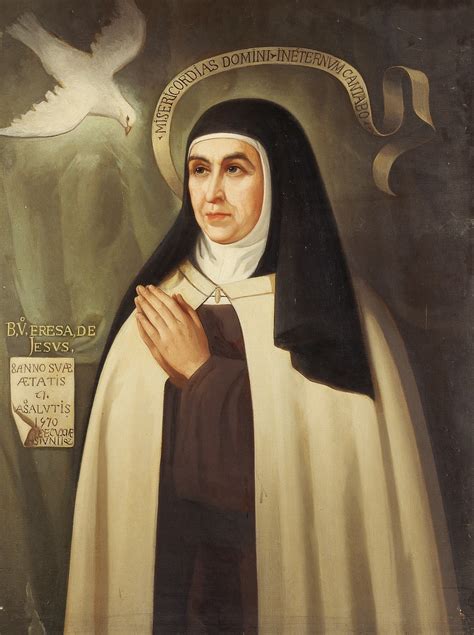
The autobiography of (Saint) Teresa of Ávila is a most remarkable book. Its beginning sections on Teresa’s early life feel at once relatable (she recalls her youthful interest in making herself pretty) and utterly alien: she and her brother admired the Christian martyrs so much that in childhood they “agreed to go off to the land of the Moors and beg them, out of love of God, to cut off our heads there”, and felt very disappointed that they could not find a way to do this. (Section 1.4, page 3 of the Kavanaugh-Rodriguez translation) The later sections are the more famous ones, depicting Teresa’s vivid visions of angels.
In the middle, though, the book takes an unexpected detour – nearly a hundred pages – providing instructions for prayer. I don’t believe in Teresa’s God, let alone pray to him, which made it very tempting to skip these chapters. I’m very glad I didn’t, though, because I found important things in them that I recognized as a Buddhist.
Most generally, these middle chapters detail the states of consciousness one can enter into after intensive prayer, which bear interesting resemblances to the Buddhist jhānas, and other mystical experiences besides. But the part that really struck me was where she talks about how those states can be disturbed by memories and images: “I see my soul become undone in the desire to be united there where the greater part is, and this is impossible; rather the imagination and memory carry on such a war that the soul is left powerless.” (17.6, p103) This “war” should be familiar to any Buddhist meditator, where so many thoughts start entering our minds whether we want them to or not. And what I find most striking is Teresa’s solution to the problem:
The only remedy I have found, after having tired myself out for many years, is the one I mentioned in speaking of the prayer of quiet: to pay no more attention to the memory than one would to a madman – leave it go its way, for only God can stop it and, in truth, here it remains as a slave. We must suffer it with patience as Jacob did Leah, for the Lord does us a great favor in allowing us to enjoy Rachel. (17.7, p104)
Leave it go its way, for only God can stop it. Even though these disturbances of mind aren’t good, trying to suppress them actively will only carry on the war within you; rather, you have to notice them and let them go. This advice very closely matches Brook Ziporyn’s summary of Zhiyi’s Chinese Tiantai Buddhist practice: when you let go of a desire, release it from your control, then it fades away – whereas by trying to suppress the desire, you paradoxically perpetuate it.
All this tells me that Teresa and Zhiyi have independently hit on something fundamental about the flow of human consciousness: even when we correctly recognize something in our minds as harmful or problematic, it remains counterproductive when we try to force it to stop. We need to simply let it go – neither indulge it nor resist it, as Andy Puddicombe says in his Headspace meditations. That is neither a Buddhist thing nor a Christian thing – it’s a human thing that we can discover when we enter the intentional periods of silence that we might describe as meditation or quiet prayer. Yet many seem not to discover it: Śāntideva, wise in so many other respects, tells us that we are at war with the kleśas, urging us to fight them in a way that may only serve to strengthen their hold.
I’ve enormously appreciated the work of the Buddhologist John Dunne for first pointing out this distinction between Śāntideva’s more aggressive variety of mindfulness and the more gentle letting-go of Zhiyi (and showing how that distinction shows up in a much wider variety of thinkers). Dunne refers to the former as “classical” and the latter as “nondual”. Reading Teresa gave me some pause on that terminology, for there is little that is nondual about her. Unlike Meister Eckhart, she does not point us to an ultimate nondual ground or “Godhead” that underlies both ourselves and God as normally conceived. More strikingly, there is a deep dualism in her own psychology: she believes that the devil and God are both at work in our minds, and describes a large number of our problematic drives as temptations from the former (especially in chapters 13 and 15, but really throughout the book).
Perhaps one could view Teresa as straddling the classical/nondual distinction: she is willing to allow a simple letting-go for stray memories, thinking they are placed there by God, but not for temptations that are placed there by the devil. If so, that approach still seems to me psychologically unhealthy. Puddicombe advises us in meditation to let go of all stray thoughts and feelings, whether harmful ones like anger or more indifferent or even positive ones, and his approach seems to me more effective as a way to reduce the number of bad thoughts. In Teresa’s language, it seems to me that we can avoid the devil’s influence most effectively by not fighting him too hard: our desire to fight the devil is itself something he uses against us.
The reason why Teresa does not reject memories as a whole is that memory traditionally serves a key function for prayer, namely, recollecting the life of Christ and other events of the sacra historia. This is attested from early Egyptian and Palestinian times on, e.g., in the Sayings of the Desert Fathers (Apophthegmata Patrum), in John Cassian’s Conferences, and in John Climacus’s Ladder (“Let the memory of the life of Jesus be present to you at all times, and you will find the courage to endure every hardship.”) Teresa uses the term “recogimiento” when she writes about this kind of memory. In prayer, personal and theological memory are inseparable – certain memories are useful, others are neutral, others again harmful. Her advice seems to be that one has to discern the nature of those memories.
There are instances in early meditation literature that suggest that memories aren’t the cause of disturbances, and that it is only passions that disturb the mind. E.g., Evagrius Ponticus, On the Eight Thoughts II.19, says that remembering a person one desires without passion is a sign of the attainment of monastic virtue. Teresa knowingly or unknowingly continues the tradition of presenting memory as a tool and indicator of monastic perfection.
Regarding nonduality, Teresa makes strong statements about union with God in the Interior Castle, for example in the fifth mansion. While she isn’t an intellectualist like Meister Eckhart and doesn’t assimilate Platonic vocabulary, it would be difficult to maintain that there’s a generic difference between their conceptions of union. It’s a “Mystical Marriage” kind of union that ultimately doesn’t allow for any conceptual differences. Meister Eckhart also espouses (no pun intended) this kind of union and language in his sermons.
I’m not convinced that categorizing meditation techniques according to their healthy or unhealthy effects is self-evident. It would be easier to argue that the differences are due to specific soteriological parameters. Christian soteriology has a strong historical dimension – it has a “history of salvation,” which requires memory and other mental faculties as tools on the path to union. The life of Christ is central to meditation and to practitioners’ own life experience. Buddhism tends to express the structure of meditation in a more spatial or cartographic language. It seems to me that the differences in the treatment of memory emerge from these differences in perspective rather than in one being healthy and the other one unhealthy.
There’s a lot to be said on these topics and I don’t claim to be any sort of expert on Teresa, or on Christian mysticism generally (though I’ve studied Eckhart in a bit more detail). I will say though that I think it’s important we not reduce everything to soteriological differences. That’s the point I was trying to make at the end, in particular: even given Teresa’s starting point that some thoughts are of God and some of the devil, it is still going to be psychologically ineffective to try to fight the devil’s thoughts rather than notice them and let them go. That’s why even though my own Buddhist faith is more connected to Śāntideva and the suttas, in the classical styles, I have nevertheless found the nondual style far more effective.
Wonderful!
You might be interested in these works (if you haven’t already read them):
The Stages of Christian Mysticism and Buddhist Purification: Interior Castle of St Teresa of Ávila and the Path of Purification of Buddhaghosa
by Lance Cousins
https://www.taylorfrancis.com/chapters/edit/10.4324/9780203985748-13/stages-christian-mysticism-buddhist-purification-interior-castle-st-teresa-%C3%A1vila-path-purification-buddhaghosa-lance-cousins
Emptiness and Unknowing
An Essay in Comparative Mysticism
by Rupert Gethin
https://journal.equinoxpub.com/BSR/article/view/9112
And the PhD thesis
The Path and the Castle. A Comparative Study of The Path of Purification of Buddhaghosa and The Interior Castle of Saint Teresa of Ávila: An Analytical Study on their Similarities in the Dynamics of Spiritual Life
https://www.academia.edu/40221333/The_Path_and_the_Castle_A_Comparative_Study_of_The_Path_of_Purification_of_Buddhaghosa_and_The_Interior_Castle_of_Saint_Teresa_of_%C3%81vila_An_Analytical_Study_on_their_Similarities_in_the_Dynamics_of_Spiritual_Life
Ah, I hadn’t realized this ground had been trod before! Though I see they’re all working with the Interior Castle, which I haven’t read; I don’t know if Teresa has the same approach there that she has in the autobiography.
The Interior Castle is the more systematic and complete mystical work of Teresa. In fact, when she wrote her Life, she had not yet reached the highest levels described in the Castle.
In my case, I knew about these works for a long time, but consciously refrained from actually reading them, because of the prejudice that there can’t be anything in common between (especially “early”) Buddhism and Christianity.
Only very recently, I finally decided to read them, and I am happy that I did! I like Rupert Gethin’s “perennialist” view, substantiated by a careful textual analysis, very much.
Another point:
Interestingly, it seems that “mindfulness” that I learnt in the Thai Forest Tradition a quarter century ago is exactly what you (and others) call “nondual mindfulness”.
For instance, Ajahn Sumedho would often say things along these lines: “let go of everything, don’t fight anything, good or bad.”
In this talk, Ajahn Sumedho explains that Right Effort is… No Effort!
https://www.youtube.com/watch?v=6kwyz8QfHSo
And :
https://youtu.be/MBj33bzcOfk?si=pf5_Ws6QTT2WSYDV
Yeah, Dunne’s work mentions that some forms of nondual mindfulness are found in Theravāda traditions; I think he might mention Sumedho and the Thai forest tradition specifically. I don’t know much about it – I’d be interested to know where Sumedho’s approach comes from.
Indeed, I now see that Dunne has published extensively on Buddhist meditation and mindfulness, not only on Buddhist epistemology.
Thank you for the pointer!
Ajahn Sumedho’s approach is what he learnt in Ajahn Chah’s Thai “Forest Sangha” tradition.
https://en.wikipedia.org/wiki/Forest_Tradition_of_Ajahn_Chah
There was some speculation that their views/practice might be somewhat “heterodox”, but it does look now that it is a legitimate instantiation of (Thai) Buddhism.
Thank You